How Formed Spring Steel Clips Cut Assembly Time and Cost on the Production Line
Comments Off on How Formed Spring Steel Clips Cut Assembly Time and Cost on the Production LineProduction teams are constantly looking for ways to make assembly faster without sacrificing reliable fastening. Small changes to the fastening process can make a meaningful difference when they are repeated across hundreds or thousands of parts. Formed spring steel clips offer a practical option by combining secure retention with quick installation.
Unlike conventional nuts and fasteners that may require additional tools, welding, or multiple assembly steps, spring steel clips can attach directly to a panel and remain in position. These reduce assembly time fasteners can help manufacturers simplify production while supporting consistent results.
Why Assembly Speed Matters
Assembly time directly affects production costs. When workers spend extra time positioning hardware, holding loose nuts, or using additional tools, those seconds can accumulate across a high-volume production run.
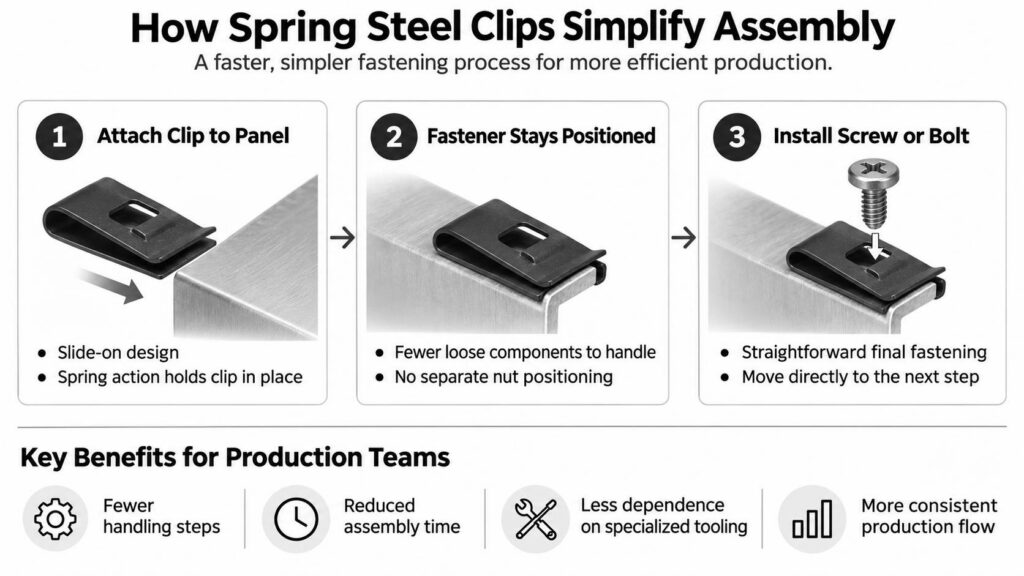
Formed spring steel fasteners can help streamline these tasks by keeping the fastening component attached to the panel before the final screw or bolt is installed. This reduces the number of individual components that need to be handled and can make installation more straightforward.
For manufacturers focused on fastener assembly efficiency, reducing unnecessary handling is one practical way to improve production flow. Faster installation can also help production teams maintain consistent cycle times as order volumes increase.
No-Thread, Slide-On Design Advantages
Many formed spring steel clips use a slide-on design that allows the fastener to attach directly to the edge of a panel. The spring action holds the clip in place until the mating screw or fastener is installed.
This approach can eliminate the need for operations such as tapping threads directly into a panel or welding a separate nut into position. It also reduces the chance of loose hardware moving around during assembly.
These are key spring steel clip nut benefits for applications where speed and ease of installation matter. Instead of adding a separate fastening component at the assembly station, workers can position the clip quickly and move directly to the next step.
Reducing Labor & Tooling Costs
Labor is one of the largest considerations in high-volume manufacturing. A fastening method that saves only a few seconds per part can create significant savings over a large production run.
Formed spring steel clips can reduce the number of assembly operations required for certain applications. Their simple installation can also reduce dependence on specialized tooling or equipment associated with alternative fastening methods.
Using reduce assembly time fasteners strategically can therefore address both production speed and labor requirements. The result is a fastening process that requires fewer handling steps while maintaining the retention needed for the application.
Real-World Use Cases (U-Clips, Twin Nuts)
ACS Manufacturing offers several formed spring steel fasteners designed for different assembly requirements.
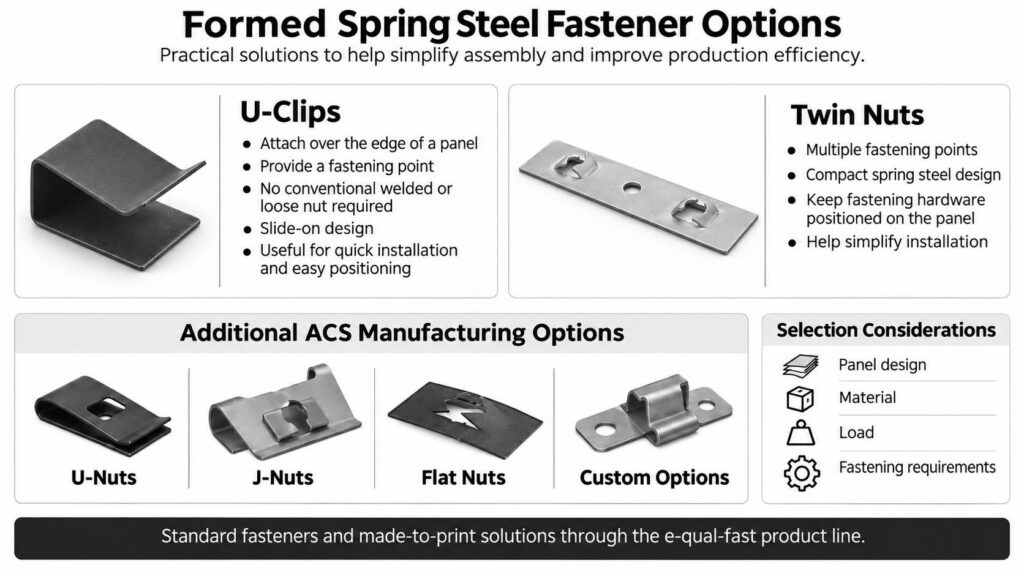
U-Clips attach over the edge of a panel and provide a fastening point without requiring a conventional welded or loose nut. Their slide-on design makes them useful when quick installation and easy positioning are important.
Twin Nuts provide another option for applications requiring multiple fastening points in a compact spring steel design. Like other formed fasteners, they can help simplify installation by keeping the fastening hardware positioned on the panel.
These examples demonstrate how the spring steel clip nut benefits can extend beyond one specific application. Selecting the appropriate clip based on panel design, material, load, and fastening requirements can improve overall fastener assembly efficiency.
Where ACS Mfg Fits In
ACS Manufacturing produces a wide range of formed spring steel fasteners, including U-Clips, Twin Nuts, U-Nuts, J-Nuts, Flat Nuts, and custom options. Its e-qual-fast product line gives manufacturers access to standard fasteners as well as made-to-print solutions.
For production teams evaluating ways to reduce assembly time fasteners can provide practical improvements without adding unnecessary complexity, ACS Manufacturing can help identify an appropriate formed spring steel solution. Contact ACS Mfg to discuss your application and fastening requirements.
J-Nuts vs. U-Nuts: Which Spring Steel Fastener Is Right for Your Application?
Comments Off on J-Nuts vs. U-Nuts: Which Spring Steel Fastener Is Right for Your Application?Choosing the right clip nut can simplify assembly, reduce installation time, and provide a reliable threaded connection without tapping the panel itself. J-Nuts and U-Nuts are two common spring steel fastener types used for sheet metal applications, but their different shapes affect how they attach, retain, and perform. Understanding the differences between a J-nut vs U-nut can help engineers and buyers select a fastener that fits their panel, screw, and assembly requirements.
What Is a J-Nut?
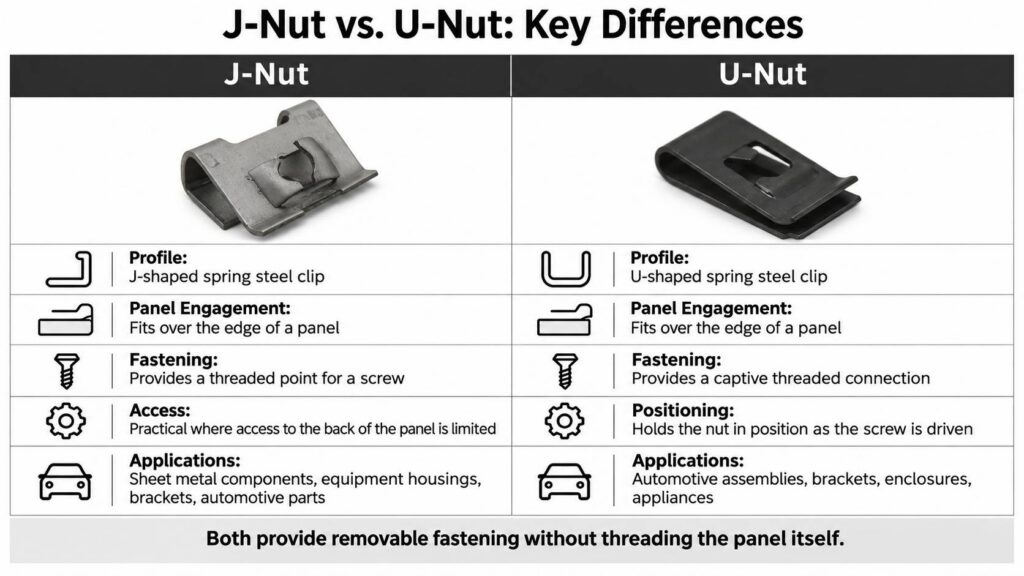
A J-Nut is a spring steel clip nut with a J-shaped profile that grips the edge of a panel. Its threaded section provides a fastening point for a screw without requiring threads to be formed directly into the panel. This makes J-Nuts practical for assemblies where access to the bottom of the panel is limited.
J-Nuts are commonly used on sheet metal components, equipment housings, brackets, automotive parts, and other assemblies that require removable fastening. The clip can be positioned on the panel before the screw is installed, helping streamline production and service work.
What Is a U-Nut?
A U-Nut uses a U-shaped spring clip that fits over the edge of a panel. Like a J-Nut, it provides a captive threaded connection while allowing the panel to remain unthreaded. The clip holds the nut in position as the screw is driven into the threaded section.
As a sheet metal clip nut, a U-Nut is useful for applications that require quick installation and removable fastening. Its compact clip design makes it suitable for brackets, enclosures, appliances, and other components made of sheet metal or plastic.
Key Structural & Application Differences
The main difference between a J-Nut and U-Nut is their clip configuration. A J-Nut uses a J-shaped profile, while a U-Nut wraps around the panel edge with a U-shaped profile. These differences affect panel engagement, positioning, and accessibility during assembly.
For a J-nut vs U-nut comparison, consider how the clip will sit on the panel and how easily the screw can be installed. The available panel edge, mounting location, and required retention can all affect which option fits the application.
Load, Panel Thickness & Material Considerations
Panel thickness, screw size, expected load, and operating conditions should be considered before selecting a clip nut. The fastener must fit the panel correctly and provide sufficient thread engagement for the intended connection.
- Key factors: panel thickness, screw dimensions, load requirements, vibration, material, finish, corrosion exposure, and installation access.
The material and spring characteristics of the sheet metal clip nut also matter. Selecting a clip that matches the panel material and application helps provide consistent retention without damaging the panel, whether it is made of sheet metal or plastic.
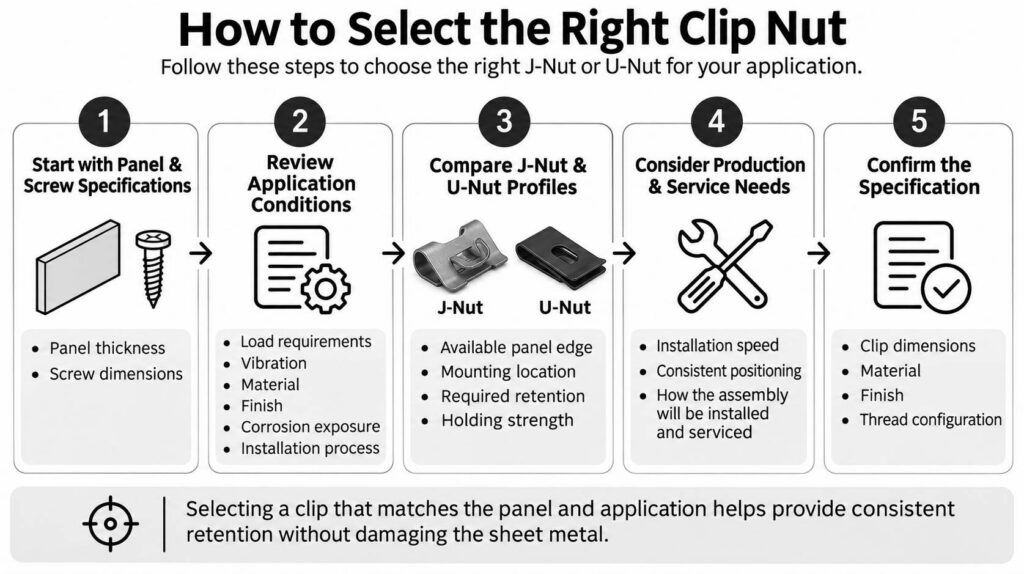
How to Choose the Right Fastener
Start with the panel and screw specifications, then consider how the assembly will be installed and serviced. Compare the J-Nut and U-Nut profiles against the available panel edge and required holding strength.
For high-volume production, installation speed and consistent positioning may also influence the selection. Your supplier can help confirm the appropriate clip dimensions, material, finish, and thread configuration based on your application.
Get Expert Help from ACS Mfg
ACS Manufacturing can help engineers and buyers identify spring steel fastening options for their specific assembly requirements. Whether you need a J-Nut, U-Nut, or another spring steel fastener type, providing details such as panel thickness, screw size, material, and application conditions can help narrow the right specification.
Contact ACS Manufacturing to discuss your fastening requirements and find a clip nut suited to your assembly.